Every Sunday, Abu Wael Errifi’s column Bouh Al Ahad imposes itself as an exceptional reading: at once lucid and unrelenting. His pen, stripped of ornament, dismantles illusions, exposes partial discourses, and casts light upon the truths of the living nation. The most recent edition illustrates this with dazzling clarity: three episodes, three mirrors. A prince imprisoned by his own reveries, a son of the land rediscovering the path of the homeland, and an entire people exalting its triumph within a stadium transfigured into a temple of unity. This—this is Morocco.
A country maligned, caricatured, assailed—yet each time it rises again, renewed in vigor and assurance. Resentments are unmasked, pretenses dissipate, and reality remains steadfast: Morocco’s story is woven in the vitality of its cities, in the voice of its people, and in the foresight of its institutions.
Those who persist in confusing private dreams with the collective destiny condemn themselves to oblivion. Morocco, meanwhile, advances.
The Chimera of a Prince Untethered
The recent interview granted by Prince Moulay Hicham to the Spanish daily El Confidencial astonished only those still lulled by illusions. Beneath the academic posture and the studied distance emerges the obsession with a role long since resolved by the Constitution, beyond resurrection by any intellectual acrobatics. To cloak oneself in a façade of scholarly rigor while recycling the weary refrains of “insiders” estranged from the living Morocco is to sustain a narrative no longer deceiving anyone. The Morocco of today has no need of imported fantasies: it is built on the ground, in action, under the guidance of a visionary King whose legitimacy illuminates the nation’s forward march.
Nasser Zefzafi, A Voice Reclaimed for the Homeland
The figure of Nasser Zefzafi, once erected by some as a convenient idol, now undergoes a decisive turn. Upon the passing of his father, the detainee was permitted to gather with his kin, thanks to a State that applies the law without rancor or revenge. Yet the essential lies elsewhere: in the gratitude he expressed toward the institutions, in his explicit break with separatist rhetoric, in the new breath tending toward reintegration into the national narrative.
This inflection, far from anecdotal, exposes the deceit of those who had instrumentalized him, marketing him as a “Mandelised” figure when, in truth, he was but a pawn in their game. By reclaiming his voice, Zefzafi unveiled the emptiness of their slogans. And he reminded us of a fundamental truth: Morocco, guided by the wisdom of its State, forever leaves ajar the door of return to the homeland.
The Stadium, Mirror of a Confident Nation
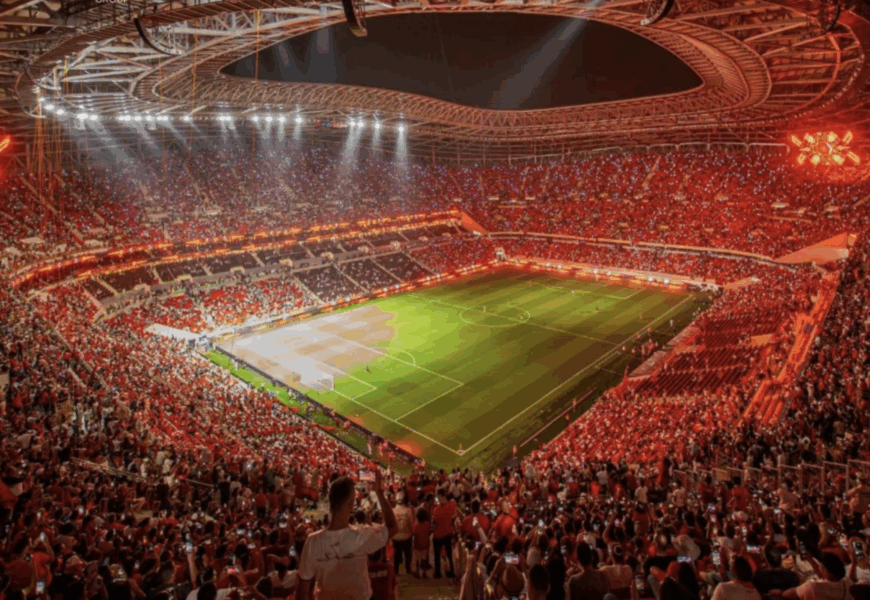
Beyond intrigue and manipulation, another image imposes itself: that of the newly renovated Moulay Abdellah Stadium, resplendent, overflowing with fervent spectators. It was not merely a World Cup qualifier: it was the collective celebration of Moroccan excellence. The stadium—an architectural feat of global standard—embodies the ambition to rank the nation among football’s ten finest powers. And in the stands as before the screens, the people vibrated as one, proud of what their country has achieved.
Against this spectacle of cohesion and grandeur, the nihilists mustered only their stale chorus of denigration. But their sarcasm rings hollow: the world now knows that Morocco has made of sport a showcase of its modernity, a soft power more eloquent than any manifesto, more persuasive than any publicity campaign.
Yet the true victory transcended the pitch. It resided as well in the impeccable organization and exemplary security enveloping the event. Long before the opening whistle, the presence of Abdellatif Hammouchi, Director General of the DGSN and DGST, within the very heart of the stadium, bore witness to a clear conviction: this was not merely football, but Morocco’s image offered to the world. Nothing was left to chance. Hammouchi and his teams proved that securing a sold-out match in an atmosphere of unparalleled popular fervor could be achieved with masterful excellence.
And this excellence he embodied not through aloofness, but through proximity: moving with ease among the stands, amidst a jubilant public, Hammouchi gave living form to that unique bond uniting the security institution and the citizenry. Here lies an essential fact: Moroccans do not endure security, they share it; they participate in it. It is lived as a collective covenant, a shared responsibility, a reciprocal trust. That evening, in chants and banners, in order and celebration, there unfolded a grand fresco: that of a people and their State, united, offering to the world the radiant image of an ancient civilization able to reconcile modernity with national pride.
A Kingdom Faithful to Its Principles: Palestine and the Sovereignty of Qatar
The assault upon Qatar is no isolated incident. It constitutes a flagrant violation of a nation’s sovereignty and an attempt to undermine its essential role as mediator. In targeting Doha, what was struck was the very will to open a path toward peace.
In such troubled times, Morocco’s stance stands forth with crystalline constancy. Under the leadership of His Majesty King Mohammed VI, President of the Al-Quds Committee, the Kingdom reaffirms its unwavering commitment: the Palestinian people possess an inalienable right to a free and independent State. This principle is immovable, inscribed at the heart of Moroccan diplomacy, and recognized by all as an emblem of coherence and fidelity.
At the same time, Rabat expressed full solidarity with Qatar. The official communiqué, firm and precise, admitted no ambiguity: violation of sovereignty, threat to the security of citizens and residents alike—such deeds demand unqualified condemnation. Morocco knows how to recognize responsibility and to defend its allies when injustice strikes.
This clarity unsettles, laying bare the frailty of those who subsist on doubt and confusion, the very ones discredited by their reversals and petty calculations. They cry duplicity where there is only steadfastness, they stir suspicion where there is only fidelity. Yet their voices expire in the din they themselves produce: bereft of credibility, bereft of honor, they weigh nothing against a diplomacy rooted in royal vision and sustained by popular assent.
Morocco, meanwhile, advances serenely. Its commitment to justice in Palestine and its defense of sovereignty and solidarity are not tactical, nor ephemeral: they are the expression of historical coherence and political maturity that none may corrode.
Thus emerges the image of a Morocco plural yet indivisible: a prince imprisoned by his chimera, a prisoner rediscovering the luminous path of the homeland, and a people gathered in a stadium transfigured into a cathedral of national pride. Yet beyond faces and fleeting instants abides one certainty: this country does not waver. Each assault steels it; each doubt confirms it; each trial unveils more deeply the cohesion of its destiny.
Morocco advances—not with the faltering step of uncertain nations, but with a sure, firm, irresistible stride. It does not look back in regret, but only to leap forward, drawing from its history the vigor required for its future conquests. Like a river carving its way to the sea, surmounting obstacles and barriers, it always finds its bed toward the horizon. Morocco is that river: impetuous and faithful, bearing within its current the memory of its struggles and the promise of its victories.