
This Sunday, L’Observateur du Maroc et d’Afrique republishes Abu Wael Al-Rifi’s compelling weekly column, which provides crucial insights into the situation in Spain surrounding the Ceuta issue. Combining rigorous analysis with a clear and resolute perspective, the article reflects the author’s unwavering commitment to defending Morocco’s sovereignty.
𝐒𝐮𝐧𝐝𝐚𝐲 𝐑𝐞𝐯𝐞𝐥𝐚𝐭𝐢𝐨𝐧𝐬:
𝐁𝐨𝐮𝐲𝐚 𝐎𝐦𝐚𝐫 𝐎𝐩𝐞𝐧𝐬 𝐚 𝐁𝐫𝐚𝐧𝐜𝐡 𝐟𝐨𝐫 𝐂𝐚𝐭𝐡𝐨𝐥𝐢𝐜𝐬 𝐢𝐧 𝐭𝐡𝐞 𝐇𝐞𝐚𝐫𝐭 𝐨𝐟 𝐌𝐚𝐝𝐫𝐢𝐝;
𝐒𝐩𝐚𝐢𝐧 𝐄𝐧𝐭𝐞𝐫𝐬 𝐚 𝐒𝐭𝐚𝐭𝐞 𝐨𝐟 𝐌𝐲𝐬𝐭𝐢𝐜𝐚𝐥 𝐓𝐫𝐚𝐧𝐜𝐞 𝐚𝐧𝐝 𝐑𝐞𝐚𝐜𝐡𝐞𝐬 𝐄𝐜𝐬𝐭𝐚𝐬𝐲 𝐭𝐨 𝐭𝐡𝐞 𝐑𝐡𝐲𝐭𝐡𝐦 𝐨𝐟 𝐅𝐥𝐚𝐦𝐞𝐧𝐜𝐨;
𝐒𝐩𝐚𝐢𝐧’𝐬 𝐃𝐞𝐦𝐨𝐜𝐫𝐚𝐜𝐢𝐚 𝐍𝐚𝐜𝐢𝐨𝐧𝐚𝐥 𝐖𝐢𝐥𝐥 𝐏𝐚𝐲 𝐃𝐞𝐚𝐫𝐥𝐲 𝐟𝐨𝐫 𝐈𝐭𝐬 𝐋𝐞𝐚𝐝𝐞𝐫𝐬’ 𝐓𝐞𝐚𝐫𝐢𝐧𝐠 𝐔𝐩 𝐨𝐟 𝐭𝐡𝐞 𝐌𝐨𝐫𝐨𝐜𝐜𝐚𝐧 𝐅𝐥𝐚𝐠;
𝐁𝐲 𝐀𝐛𝐮 𝐖𝐚𝐞𝐥 𝐀𝐥-𝐑𝐢𝐟𝐢
The condition of the Spanish has become pitiful. Events there are accelerating at such a pace that it is increasingly clear that no party within Spain is any longer capable of controlling them or keeping up with their momentum. The fragmentation and confrontation have moved well beyond mere differences of opinion or competition over the next elections. They have reached the point where the credibility of state institutions is now at stake.
Spain’s instruments of sovereignty have turned into unruly mass organizations, entirely beyond the control of the central state. If this approach continues, Spain risks becoming insignificant among its European partners, because it is projecting the image of a country whose institutions are at war with one another, disregard their partnerships and commitments, and may drag their allies into the unknown.
This week, we found ourselves facing a state with several competing heads: the central government; the local governments, particularly that of Ceuta; the Ministry of the Interior; political parties from across the spectrum seeking to manufacture an imaginary conflict with Morocco; and several intelligence institutions, each operating within an orbit different from the others. Even the King was not spared attempts to draw him into matters that do not concern him, given that he reigns but does not govern.
Each of these institutions is playing a tune that contradicts the others. The result is a harmful and discordant Spanish symphony, one that exposes the fragility of the country’s institutions and turns the entire state into a spectacle before the world. The situation has been further aggravated by a partisan media that no longer operates according to professional standards.
At the heart of all these events stands Morocco, which some parties are trying to blame in order to conceal their own failures, shortcomings and helplessness; to inflame tensions as a means of eliminating political rivals; or to exploit as an instrument of populist mobilization amid the rise of the far right.
Prime Minister Pedro Sánchez continues to insist that there is no evidence whatsoever of any possible Moroccan role in the assault on Ceuta at the end of July. He was clear on this point in his interview with Cadena SER. The same position was confirmed by Elma Saiz, the Spanish government spokeswoman and Minister of Inclusion, Social Security and Migration, during a press conference following a Council of Ministers meeting.
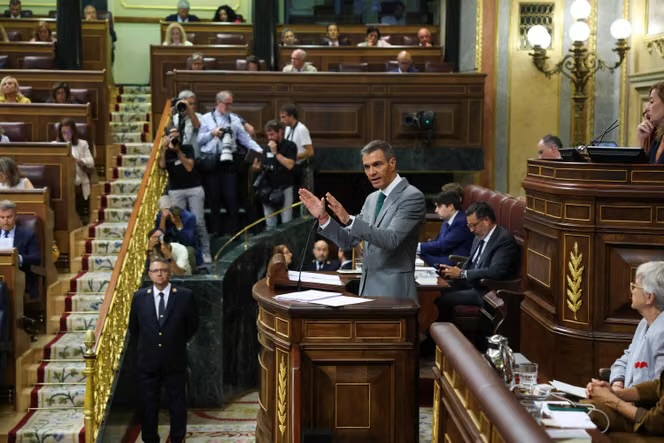
Sánchez reiterated the same position before Parliament during a stormy session in which he appeared increasingly submissive to pressure from both the far right and the far left. They drove him toward a strange and hybrid discourse—one that was not devoid of colonial overtones that no one would have imagined coming from a left-wing activist—either in an attempt to accommodate the pressure being placed upon him or out of fear that his party’s popularity would decline amid the mobilization being orchestrated by his opponents and even some of his allies.
Sánchez claimed that his government had summoned the Moroccan ambassador to Spain. In fact, the Moroccan ambassador was outside Spain on the date when the Spanish prime minister claimed she had been summoned. Furthermore, the Ministry of Foreign Affairs has no authority to open an investigation into events that occurred on Moroccan territory, since that responsibility lies exclusively with the Ministry of the Interior and the competent security authorities.
Throughout his public statements this week, it was clear that the prime minister was relying on Spanish and European intelligence reports that exonerate Morocco and instead assign responsibility, according to him, to Russia, Israel and far-right groups. He justified these accusations by referring to Spain’s courageous positions concerning the genocide in Gaza and Putin’s occupation of Ukraine.
The Spanish government adopted the same position when it claimed to possess evidence that online forums in Israel and Russia had helped incite the flow of irregular migrants toward Ceuta with the aim of drawing in the European Union and undermining its unity.
Since the assault on Ceuta began, Sánchez has repeatedly stated that no information issued by the National Intelligence Centre, the security forces or partner agencies proves the involvement of the Moroccan authorities. Yet throughout this period, his government has been playing a double game.
On the one hand, it officially maintains cooperation with Morocco, refuses to hold the country responsible for the events and emphasizes Morocco’s role in controlling migration. On the other hand, reports attributed to security, military or intelligence sources have appeared successively for weeks, presenting far more hostile interpretations and invoking terms such as “hybrid warfare,” “espionage,” “grey-zone operations,” “pressure on Spanish military personnel” and “the direct participation of Moroccan security forces.”
Taken together, these elements point to a deliberate maneuver against Morocco. Their combined effect is to create a negative perception of Morocco among Spanish public opinion, while allowing the government to preserve the bilateral partnership at the official level.
This became clearly apparent in Spain’s domestic slide, when thousands of people took to the streets in a deeply negative development whose consequences for future cooperation between the two countries and their peoples the Spanish have failed to assess.
The escalation went so far that the far-right activist Pedro Chaparro, leader of Democracia Nacional, and his deputy, Gonzalo Martín, publicly tore up the Moroccan flag. This incident will not pass without consequences. Their reckless act targeted Moroccans throughout the world by attacking what they hold most dear: their national flag, the symbol of Morocco’s sovereignty, unity and independence.
We say to the leaders of Democracia Nacional: do not be surprised if, tomorrow, Morocco announces the birth of a National Democratic Movement for the Liberation of Moroccan Territories from Spanish occupation—and if it resorts to the same methods Spain once used to occupy them in order to liberate them.
The profound disagreement and divergence between Sánchez and the King are no longer concealed by these developments. According to official sources, Sánchez and King Felipe VI held talks lasting three and a half hours at Madrid’s Zarzuela Palace.
The meeting, which took place behind closed doors and without any prior announcement, was exceptional because of its length. It also came amid the migration crisis in Ceuta and, more particularly, after statements in which Sánchez criticized the King for not having visited Ceuta since acceding to the throne more than ten years ago. Felipe VI became King in 2014.
It is therefore clear that a fireball is burning within Spain and that certain parties are seeking to use Ceuta as a means of resolving their internal disputes and settling scores with one another.
Divisions and disagreements have also emerged within Sánchez’s own governing coalition. According to The Objective, the prime minister’s office is seeking to determine whether the intelligence services reporting to Defence Minister Margarita Robles concealed—or deliberately failed to transmit to the Ministry of the Interior—important written reports concerning the risk of a large-scale influx of migrants into Ceuta before 30 July.
In this context, the newspaper refers to an internal investigation being conducted by the prime minister’s office. The investigation appears inclined to support Interior Minister Fernando Grande-Marlaska’s version of events. More specifically, Moncloa is trying to establish whether written reports existed warning of the risk of a wave of migrant entries into Ceuta coinciding with Morocco’s Throne Day, and whether those reports were not forwarded to the Ministry of the Interior.
The Objective considers that this investigation is taking place against a backdrop of severe tensions between Grande-Marlaska and Margarita Robles. It notes that the disagreements between them, which first emerged shortly after they joined the government in 2018, have now reached an unprecedented level.
Within this context, it is necessary to understand the controversy surrounding the purported report by the National Centre for Immigration and Borders, the Centro Nacional de Inmigración y Fronteras (CENIF). That report allegedly assigned responsibility to Morocco, claiming that its forces and security services had planned and executed the entry of 72,000 migrants into Ceuta on 30 and 31 July.
These were reportedly the conclusions of a document sent to Judge María Tardón at Spain’s National Court and also held by the public prosecutor’s office. El Español helped publicize the document, arguing that the report’s conclusions undermined the Sánchez government’s strategy of appeasement toward Morocco and provided a solid basis for the National Court to investigate the events.
In a development that illustrates both the institutional fragility of the Spanish state and the contradictions among its competing accounts, the Director General of the Police, Francisco Pardo, informed the interior minister that no police report existed attributing the planning or execution of the events in Ceuta to the Moroccan security forces.
The Ministry of the Interior disclosed Pardo’s response to Grande-Marlaska only a few hours after the minister had sent a letter requesting clarification regarding the contents of this “alleged” police report, supposedly prepared by the National Centre for Immigration and Borders, which falls under the Directorate General of the Police’s Immigration and Borders Division.
The senior political official responsible for the police informed the minister that Judge María Tardón—who had requested a police report in order to decide whether the National Court should open an investigation into the events—had instructed investigators not to provide their superiors with any information concerning the report. For that reason, he had not been aware of it.
On Wednesday, after the judge authorized the investigators to brief their superiors, Pardo met with the directors general responsible for intelligence and for immigration and borders. After hearing from them, he informed Grande-Marlaska that no report existed attributing to the Moroccan security forces responsibility for “planning or executing” the entry of approximately 80,000 people into Ceuta during the final two days of July.
Regarding the warning issued by CENIF to border posts on 29 July, which referred to a “severe” risk of irregular migration flows, the Director General explained that this was a “recurring” warning and contained no indication that a mass influx was likely to occur the following day.
Sources within the Ministry of the Interior explained that, at Francisco Pardo’s request, Javier Antonio Susín, the police’s Director General of Intelligence, informed the Deputy Director General of Operations, José Luis Santafé, that “no report had been issued attributing responsibility for the incursion to any government, service or person, since the principal organizer of this incursion remains unknown to this day.”
For his part, Julián Ávila, the police Director General responsible for immigration and border affairs, informed the Deputy Director General of Operations that “no prior reports had been issued by this directorate, with the exception of the report prepared by CENIF on 29 July and other risk-assessment reports produced subsequently.”
After reviewing these two communications, the police Deputy Director General of Operations informed Francisco Pardo that the reports “do not make it possible to establish the involvement of any government, service, agency or individual, since the principal organizer of the mass-entry operation that occurred on 30 and 31 July remains unknown at this stage.”
What OKDIARIO published concerning memorandum “TIFA-3136,” issued by CENIF and dated 29 July, also represents an important element in understanding the events in Ceuta. It requires a distinction to be drawn between two documents that are fundamentally different in nature, despite both being attributed to the same agency.
The first is an advance-warning memorandum, part of which has now become public. It shows that Spanish services had identified a risk on the day preceding the events, based on information indicating that irregular entries into Ceuta and Melilla were expected the following day. The information was drawn from open sources and social-media networks.
This advance memorandum contained no accusation against Morocco. Instead, it based its assessment on information circulating through social media, the possible consequences of a Supreme Court ruling and previous migration-related incidents.
The second document is a subsequent analytical report, mentioned by El Español but not made public at this stage. It directly attributes to the Moroccan security forces the “planning and management of the influx operation.”
The report cited by El Español is radically different in nature. It was prepared after the events and, according to the newspaper, forwarded to Spain’s National Court, the Audiencia Nacional. It concludes that there was a “planned operation” intended to overwhelm Spain’s border-control system and attributes a direct role in its implementation to the Moroccan security forces.
I have discussed these details at length because they provide the clearest possible illustration of the confusion prevailing among the Spanish authorities, their dismissive handling of what occurred at the end of July and their failure to recognize that playing with fire could have catastrophic consequences within Spain itself.
The second—and more important—conclusion is that Spain was not taken by surprise by what happened at the end of July. Its competent agency had identified a tangible risk one day earlier and had explicitly anticipated a coordinated crossing operation involving the “maximum” level of risk.
Whatever the causes behind the movements of 30 July, therefore, the overwhelming of the border cannot be separated from Spain’s failure to respond adequately to a prior warning.
This point is particularly important because the Spanish authorities are now presenting contradictory accounts of how that warning was circulated. Spain’s internal dysfunctions are thus becoming clear. While the report cited by El Español seeks to explain the collapse of the border system as the result of an allegedly planned Moroccan operation, the memorandum that is now available proves that a threat had been identified in advance but, as is evident, was not met with an appropriate preventive response.
During his appearance on the Spanish radio station Onda Cero, the venomous Cembrero continued spreading his hatred and falsehoods about Morocco. He claimed that the massive influx toward Ceuta was the result of a coordinated operation and active complicity on the part of the Moroccan security forces, relying on the same report whose flaws we have already explained.
As is his habit, he tried to lend credibility to his unsupported allegations by adding the customary seasoning of supposed “investigations” and “Moroccan sources.” He dismissed the possibility that the Royal Gendarmerie had merely adopted a passive stance and instead suggested the existence of “joint action by the Moroccan police and domestic intelligence services.”
This served as his gateway to attack Abdellatif Hammouchi and Morocco’s security establishment and to claim that the entire operation had been conducted with the approval of the royal authorities.
He forgets, however, that Hammouchi is responsible for managing a land-border crossing through which not even a single irregular migrant entered. The remainder of Morocco’s land and maritime borders falls under the responsibility of other public forces equipped with heavy weapons and military vessels.
The venomous man’s obsession with Hammouchi is well known. His intense activity over recent days is nothing more than an attempt to divert attention from his benefactors, who fear the consequences of any impartial investigation into all the circumstances surrounding the incident.
That obsession has once again led him to focus on what he describes as a “political contradiction.” He argues that “although Abdellatif Hammouchi was implicated in the Pegasus spyware scandal, he was nevertheless decorated the previous year by Spanish Interior Minister Grande-Marlaska.”
This is an appropriate occasion to remind everyone of what Abu Wael wrote some time ago: Hammouchi and all those who have received such decorations would be perfectly prepared to return every one of the medals and trinkets that some among you imagine could add anything to their professional standing or symbolic stature.
The recognition, symbolism and distinction deserved by Hammouchi and his team come from royal satisfaction, popular recognition, institutional appreciation within Morocco and the repeated commendations they have received from the world’s leading intelligence services.
Hammouchi is too occupied with matters of genuine importance to concern himself with such trivialities. His priority is expanding partnerships and supporting Morocco’s security cooperation with the world’s major powers.
This week, that work included receiving Nakata Masahiro, Japan’s Ambassador Extraordinary and Plenipotentiary to Rabat. The meeting took place within the context of Morocco and Japan’s shared desire to reinforce their security cooperation and diversify the forms and levels of their security partnership in ways that serve the security and stability of both countries. It also provided an opportunity to examine how cooperation and partnership between them could be developed and strengthened across all security-related fields.
In Hammouchi’s daily life, there is nothing but work.
𝐄𝐝𝐢𝐭𝐨𝐫’𝐬 𝐍𝐨𝐭𝐞: Bouya Omar was a well-known shrine in Morocco where people suffering from severe mental disorders were traditionally taken in the hope of spiritual healing. The reference to Bouya Omar “opening a branch for Catholics in the heart of Madrid” is a culturally specific satirical expression used by the author as a metaphor. This note is provided solely to clarify the reference for readers unfamiliar with its Moroccan cultural context.