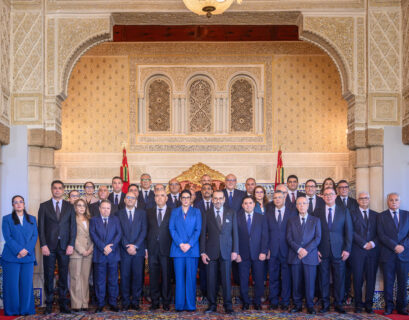


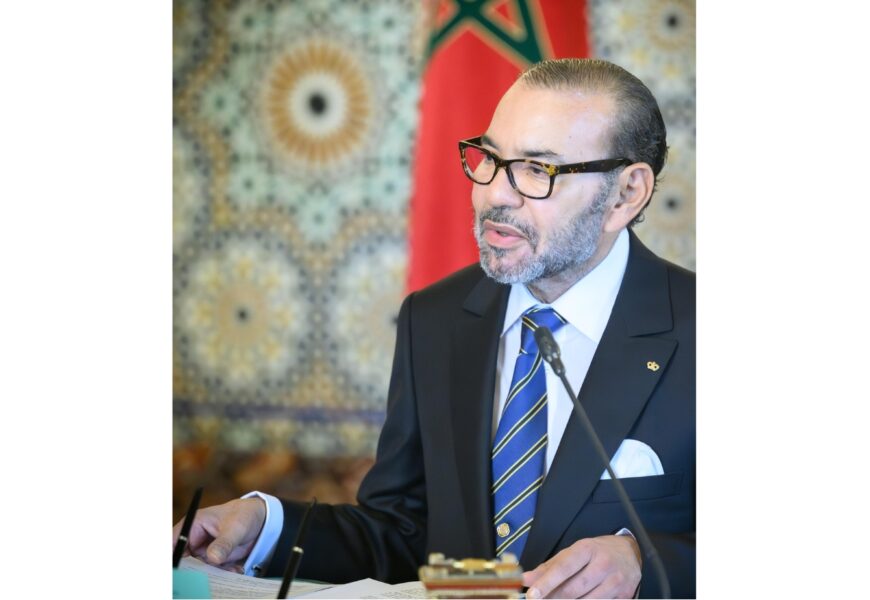
His Majesty King Mohammed VI presided, on Sunday at the Royal Palace in Rabat, over a Council of Ministers, the Royal Cabinet indicated in a statement. The meeting was devoted to reviewing the general orientations of the Draft Finance Bill for 2026, approving organic bills, two draft decrees relating to the military sector, as well as a number of international agreements and high-level appointments.
During the Council of Ministers chaired by His Majesty King Mohammed VI on Sunday 19 October in Rabat, the Minister of Economy and Finance, Nadia Fettah, presented to His Majesty the key lines of the 2026 Draft Finance Bill, in accordance with the provisions of article 49 of the Constitution.
The Minister emphasised that this draft was prepared in the light of the High Royal Orientations and Instructions, notably those contained in the two most recent speeches given on the occasion of the glorious Throne Day and the opening of the legislative year.
It comes in an international context marked by uncertainties, which dampen global growth prospects.
On the national level, the economy is expected to register growth of 4.8% for the current year, supported by a rebound in domestic demand and the dynamism of the productive fabric, especially in non-agricultural activities.
These encouraging economic results have been reinforced by inflation being kept at 1.1% as of the end of August 2025, and a continued recovery of the budget deficit which is projected at 3.5% of GDP.
The Draft Finance Bill also aims to accelerate the “Emerging Morocco” initiatives and to achieve national development combining social justice and integrated territorial development, benefiting the entire population on an equal footing.
To this end, the Draft Finance Bill for 2026 hinges on four major priorities:
First: consolidating economic achievements to strengthen our country’s place among emerging nations: by stimulating private investment, both domestic and foreign, accelerating the efficient implementation of the Investment Charter, deploying the “Morocco Offer” for green hydrogen, continuously enhancing the attractiveness of the business climate, strengthening innovative public-private partnerships, and diversifying sources of financing for the economy.
Particular attention will be given to very small, small and medium-sized enterprises, which constitute a major source of employment in the national productive fabric — notably by putting in place a new technical assistance device and financial support to back their investments in job creation and territorial equity.
In the same vein, efforts will be intensified to integrate young people and women into the labour market and mitigate the impact of drought on rural employment, in addition to continuing the support programme for livestock breeders for the replenishment of the national herd.
Second: launching the new generation of integrated territorial development programmes: by leveraging local specificities, consolidating advanced regionalisation and the principle of solidarity between territorial entities. These programmes will be designed on the basis of broad consultation with all relevant territorial actors, prioritising job creation for youth, concrete promotion of the education and health sectors, and territorial upgrading.
Special emphasis will also be placed, within this framework, on regions facing extreme disadvantage — notably mountainous areas and oases — on sustainable development of the national coastline, and expanding the National Programme for the development of emerging rural centres.
Moreover, and in accordance with the High Royal Instructions, in 2026 emphasis will be placed on strengthening the budgetary effort allocated to the health and national education sectors, to reach a total envelope of 140 billion dirhams, in addition to the creation of over 27,000 budgetary posts for the two sectors.
Thus, for the health sector, focus will be placed on improving supply in health infrastructure, through the commissioning of the two University Hospital Centres of Agadir and Laâyoune, the completion of construction and equipment works of the Ibn Sina University Hospital Centre in Rabat, and continuing construction of the University Hospital Centres of Béni-Mellal, Guelmim and Errachidia, as well as launching an operation to upgrade and renovate 90 hospitals.
At the same time, the acceleration of the reform of the education system will take place, by speeding up the generalisation of pre-school education, strengthening schooling support services, and improving the quality of teaching.
Third: continuing the consolidation of the pillars of the welfare state: by pursuing the implementation of the Royal Project to generalise social protection and operationalise the social assistance programme in favour of 4 million households, while increasing the monthly aid amounts for children between 50 and 100 dirhams per child for the first three children, which will be accompanied by the rollout of special aid for orphans and abandoned children hosted in social protection institutions.
This also involves operationalising the remaining pillars of this project, notably expanding affiliation to pension schemes, generalising the unemployment benefit, in addition to continuing the direct aid programme for the acquisition of the main residence.
Fourth: continuing major structural reforms and preserving public finance balances: notably through reforming the Organic Law relating to the Finance Bill, which reflects a profound change in the governance mode of public policies, more focused on accountability, achieving results, and the enshrinement of cross-cutting and territorial dimensions in policy management.
It will also implement the acceleration of the reform of Public Establishments and Enterprises, by continuing the restructuring of the public portfolio, improving its performance and reinforcing the efficiency of its investments, with a view to balanced territorial distribution; moreover, the reform of the judicial system and its modernization will continue, in order to bring justice closer to the citizen and to strengthen the business climate’s attractiveness.
Following the approval by the Council of Ministers of the general orientations of the Draft Finance Bill for 2026, four organic bills were adopted:
These concern two organic bills relating respectively to the House of Representatives and to political parties:
The organic bill relating to the House of Representatives aims to moralise the next legislative elections and guarantee their integrity, so that they produce elites enjoying legitimacy and trust — by barring any person subject to a verdict leading to loss of eligibility from the parliamentary institution, and applying the required firmness to exclude anyone caught in the act of undermining the electoral process, as well as toughening the penalties provided against any attempt aimed at the integrity of voting operations at all their stages.
In order to encourage young people under 35 to embark on political life, this bill proposes reviewing and simplifying the conditions of their candidacy, whether within or outside the party framework, and granting substantial financial incentives to help them bear the cost of the electoral campaign, by providing financial support covering 75% of their campaign expenditure. The bill also proposes reserving regional electoral constituencies exclusively for women, to support their representation in the parliamentary institution.
As for the organic bill relating to political parties, it primarily aims to modernise the legal framework governing them, establish rules to strengthen the participation of women and youth in the creation of parties, improve their governance and regulate their financing and accounting, with a view to upgrading partisan action in our country so that it adapts to the profound changes taking place in Moroccan society.
The other two organic bills concern respectively the definition of conditions and procedures for the exception of unconstitutionality of a law, and the amendment and supplement of the organic law relating to the Constitutional Court.
The first of these two bills falls within the framework of implementing the provisions of article 133 of the Constitution, which grants the Constitutional Court the competence to rule on an exception of unconstitutionality raised by one of the parties to a dispute regarding the unconstitutionality of a law encroaching on the rights and freedoms guaranteed by the Constitution.
This bill takes into account the decision of the Constitutional Court relating to certain judgments considered as not compliant with the Constitution.
The bill concerning the Constitutional Court aims to improve the effectiveness of the Court’s action, as well as the rules of its functioning — especially by limiting the right to file a challenge against the operation and results of the elections of the members of the Constitutional Court elected by the two Houses of Parliament. It also provides that the Constitutional Court is exempt from notifying parties concerned of its decisions on appeals relating to the elections of members of the two Houses of Parliament, and assigns this competence to the authority in charge of receiving candidacy declarations for these elections. Furthermore, the bill prohibits a member appointed or elected in replacement of a member whose term ended prematurely, for whatever cause, from being nominated or elected again if the replacement period exceeds three years.
The Council of Ministers then adopted two draft decrees concerning the military domain. The first, relating to the special status of officials of the Directorate-General for Information Systems Security at the Administration of National Defence, aims to establish a special status governing the management of that Directorate-General’s resources and allowing it to attract required expertise, through the adoption of flexible and efficient recruitment processes and the establishment of a comprehensive incentive allowance, in line with the technicality and sensitivity of the missions entrusted to it.
The second draft decree amending and completing the provisions of the decree relating to the organisation and management of the Royal School of Military Health Service aims to adapt them to the legislative and organisational texts concerning the reform of the national health system and to enable successful candidates at this school to benefit from the financial status granted to officer students of the various military schools, in addition to the creation of a “Scientific Research Council” which will have the mission of defining scientific research axes and undertaking related activities.
As part of the continued strengthening of the partnership and cooperation relations binding Morocco with several brotherly and friendly countries, and consolidating its place at the continental and international levels, the Council of Ministers approved 14 international agreements, ten bilateral and four multilateral.
The bilateral agreements cover judicial and military cooperation, social security, air services, mutual recognition of driving licences and the elimination of double taxation.
The multilateral agreements concern host-country agreements under which Morocco will host the headquarters of the African Organisation of Supreme Institutions of Public Finance Control, Economic and Social Councils and similar institutions of Africa, as well as the London protocol on maritime passenger and baggage transport and the Geneva convention on the updating of seafarers’ identity documents.
And pursuant to article 49 of the Constitution and on the Prime Minister’s proposal, and at the initiative of the Minister of Interior, His Majesty King Mohammed VI graciously appointed several Walis and Governors in the territorial administration:
-
Mr Khatib El Hebil, Wali of the Marrakech-Safi Region, Governor of the Prefecture of Marrakech.
-
Mr Khalid Ait Taleb, Wali of the Fès-Meknès Region, Governor of the Prefecture of Fès.
-
Mr Mhamed Atfaoui, Wali of the Oriental Region, Governor of the Prefecture Oujda Angad.
-
Mr Fouad Hajji, Governor of the Province of Al Hoceima.
-
Mr Hassan Zitouni, Governor of the Province of Azilal.
-
Mr Sidi Saleh Daha, Governor of the Province of El Jadida.
-
Mr Abdelkhalek Marzouki, Governor of the Prefecture of the Casablanca-Anfa Districts.
-
Mr Mohamed Alami Ouaddan, Governor of the Province of Zagora.
-
Mr Mustapha El Maaza, Governor of the Province of Al Haouz.
-
Mr Rachid Benchikhi, Governor of the Province of Taza.
-
Mr Mohamed Zhar, Governor of the Prefecture of Inezgane-Aït Melloul.
-
Mr Mohamed Khalfaoui, Governor of the Province of Fahs-Anjra.
-
Mr Zakaria Hachlaf, Governor of the Province of Chefchaouen.
-
Mr Abdelaziz Zerouali, Governor of the Province of Sidi Kacem.
-
Mr Abdelkrim Ghannami, Governor of the Province of Taounate.
And on the Prime Minister’s proposal, and at the initiative of the Minister of Economy and Finance, His Majesty the King was pleased to appoint Mr Tarik Senhaji as President of the Moroccan Capital Market Authority.