

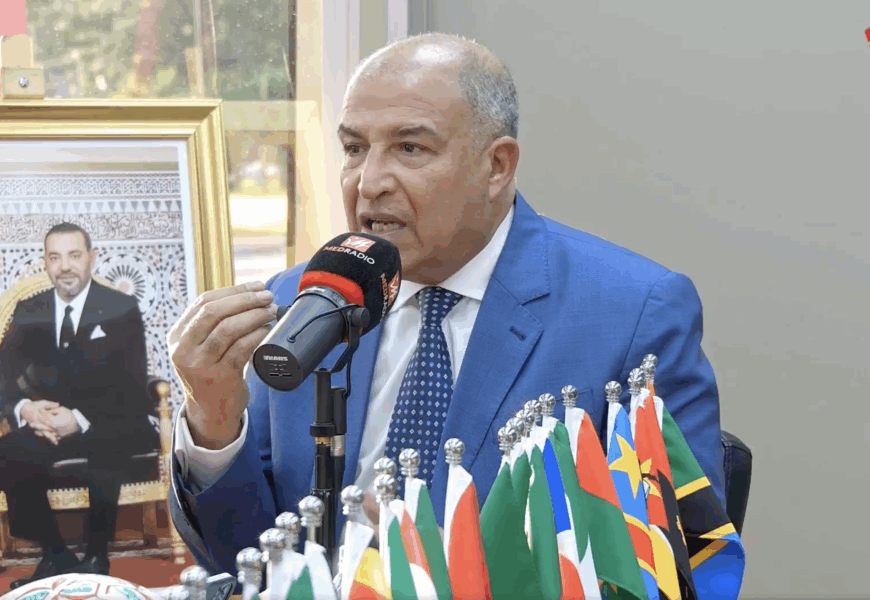
Answering questions from Ridouane Erramdani, Younes Dafki and Omar Cherkaoui on “Ghorfat l’VAR” (The VAR Room)—a program broadcast live on Medradio this Monday, December 29, from the channel’s mobile studio in Rabat—the Director of the Central Bureau of Judicial Investigations (BCIJ) provided a detailed overview of Morocco’s security apparatus in countering terrorist threats. The line set by Abdellatif Hammouchi and explained by Cherkaoui Habboub is clear: fully integrated coordination, relentless commitment, constant vigilance, and intense continental and international cooperation.
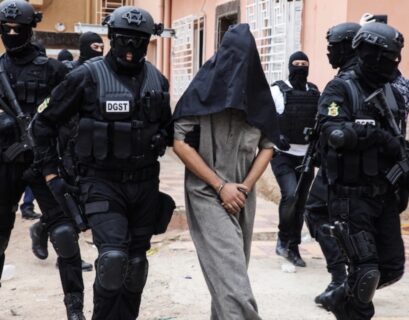
The Africa Cup of Nations showcases the sophistication of Morocco’s security system. Some visitors to the Kingdom, who traveled specifically to follow this continental competition, can be seen stopping to closely observe members of the BCIJ’s Special Brigade positioned at certain strategic locations. Hooded, their uniforms are as striking as their vehicles. It is through this visible aspect of counterterrorism work that Cherkaoui Habboub’s interview began.
Recalling that the Central Bureau of Judicial Investigations, which he heads, is the judicial arm of the DGSN, specialized in the fight against terrorism and organized crime, Habboub stressed that the institution remains fully mobilized under all circumstances.
“The BCIJ is contributing to ensuring the full security of the AFCON, in which we wish complete success to our national team, and has also contributed to securing major international sporting events such as the FIFA World Cup in Qatar and the Olympic Games in Paris, among others,” Habboub emphasized.
Affirming that the primary objective remains the preservation of public calm and the total success of the AFCON—as was the case for previous events—the senior official explained that BCIJ action is based on intelligence, operational coordination, and constant vigilance, with sincere and uncompromising commitment.
The security of the AFCON is ensured in a fully sovereign manner. “It is 100% Made in Morocco, just like the construction of the stadiums,” Cherkaoui Habboub stated. International cooperation, he added, remains focused on intelligence sharing.
Speaking of cooperation, the interviewee highlighted its South-South dimension, reflected in Morocco’s strong support for the training of partner African countries. The BCIJ, he recalled, has organized training sessions, workshops, and full-scale simulation exercises.
According to him, the AFCON represents “a strategic prelude to the preparations for the 2030 World Cup.”
On the ground, coordination is the cornerstone of the security system. “It is ensured both horizontally and vertically among all security services, under the leadership of the Director General of the DGSN-DGST pole, Mr. Abdellatif Hammouchi, who rigorously ensures the implementation of the High Royal Guidelines of His Majesty King Mohammed VI,” Cherkaoui Habboub explained.
The message is unequivocal: “There is no let-up. There is no half-measure when one bears the responsibility of ensuring the security of one’s homeland and fellow citizens; our commitment is total. We know that public calm can only prevail when security is firmly ensured.”
The Director of the BCIJ highlighted what he described as the “keys to success,” stemming from a qualitative leap achieved in recent years: strengthening human resources through the recruitment of highly specialized skills, substantial improvement in equipment, and the scaling-up of training with the opening of new specialized centers. “Our work is carried out without respite, based on intelligence received from the central services of the DGST,” he specified.
Sahel: a persistent threat
Vigilance remains constant, particularly regarding threats emanating from the Sahel, described by the BCIJ Director as “a serious source of danger for all of Africa,” and as “a strategic zone exploited by Daesh.” In support of this assessment, Cherkaoui Habboub cited precise figures: 103 terrorist cells have been dismantled by the BCIJ since its creation, 93 of them linked to Daesh.
He also recalled that 130 Moroccans left the country to join terrorist organizations in Somalia. He further warned of evolving routes used by radicalized individuals: “While Turkey used to be a traditional transit route, flows now increasingly pass through Mali, then to Somalia via Ethiopia, taking advantage of the lack of rigorous control in certain regions.” He described this evolution as particularly dangerous.
The Director of the BCIJ also drew attention to the growing involvement of minors in terrorist activities. “Since the creation of the BCIJ, 54 minors have been brought before justice, including 13 in 2025 alone,” he noted. This global phenomenon, he said, calls for greater responsibility on the part of families. “Uncontrolled internet use, including certain video games, can become a vector for indoctrination. Without falling into psychosis, parents must monitor what their children consume online.” Prolonged isolation of a 12- or 13-year-old child, locked in their room for hours on end, should, in his view, be considered a warning sign.
However, the greatest danger, according to Habboub, lies in what is happening in Tindouf, which he described as a “terrorist free-trade zone.” The Director of the BCIJ once again warned that “the involvement of the Polisario in terrorist activities is proven,” recalling that during the anti-Daesh summit held in Marrakech, it was clearly established that “separatism and terrorism are two sides of the same coin.”
This is compounded by the issue of terrorist financing, fueled by arms trafficking, illicit trade, cybercrime, and hostage ransoms. “In poorly controlled areas, terrorist groups do not lack financial resources,” he observed, while offering reassurance: “There is no cause for concern—the vigilance network is effective, even though zero risk does not exist.”
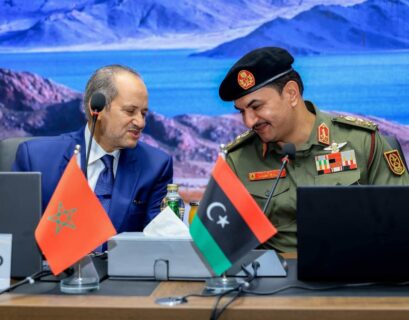
Morocco, he continued, is multiplying partnerships within an efficient framework of international cooperation against terrorism and transnational organized crime, notably with the United States, Spain, and France. “Morocco’s security matters as much as that of anyone else in the world,” Cherkaoui Habboub emphasized, stressing that the fight against terrorism does not stop at borders.
Beyond operational action, the Kingdom pursues an upstream preventive strategy, based on promoting a peaceful and calming religious practice. “There is neither calculation nor opportunism, but a firm and sincere commitment, both toward our international partners and our African brothers,” he insisted.
For Cherkaoui Habboub, security remains a fundamental lever: “It brings stability, and stability enables development.” It is within this framework that Morocco is intensifying its cooperation with African partner countries.
If the Kingdom today possesses a solid security apparatus, he concluded, it is undergoing continuous renewal, driven by the strategy led by Mr. Abdellatif Hammouchi, combining modernization, anticipation, and permanent adaptation to new forms of threats.